
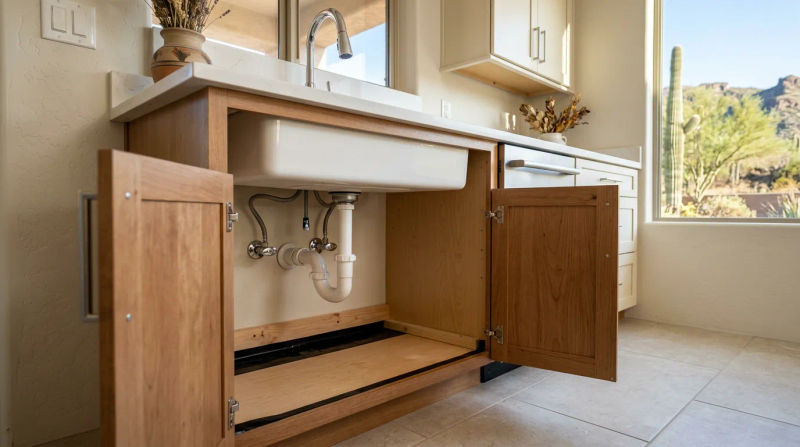
It started with a call that’s become increasingly common for my team at Napoleon’s Home Services, especially as we head into the cooler months here in Tucson. A homeowner in Tanque Verde noticed something wasn't right under their kitchen sink. It wasn't a flood or a dramatic spray, but something more subtle. The bottom of the cabinet felt… soft. Spongy, even. When they pushed on it, there was a slight give that definitely wasn’t there before.
This is a classic case of a problem hiding in plain sight. In our dry Arizona climate, especially during September, a slow drip under sink Tanque Verde can go completely undetected for weeks or months. The low humidity causes the water to evaporate almost as quickly as it drips, so you rarely see a puddle. The real evidence shows up much later, when the particleboard most builders use for cabinet bases has absorbed enough moisture to swell, warp, and lose all its structural integrity. Add a collection of cleaning supplies, trash bags, and other assorted items, and the view of the actual plumbing is often completely obscured. The homeowner had no idea a tiny, persistent drip was slowly turning their cabinet into mush.
When they called us, they were worried about the cost and disruption of a major kitchen repair. They just knew something was wrong and needed a professional eye. As a Senior Home Services Technician with Napoleon’s Home Services, this is exactly the kind of puzzle I specialize in solving. I assured them we’d get to the bottom of it, and my team and I headed over to their Tanque Verde home to investigate.
The Assessment
Upon arrival, the first step was to get a clear look at the situation. My team and I carefully removed every single bottle, box, and container from under the sink, placing them safely aside. Immediately, the extent of the damage became visible. The cabinet floor, a standard-issue particleboard panel, was severely water-damaged. It was dark, discolored, and had the texture of wet cardboard. A faint, musty odor confirmed that moisture had been sitting there for quite some time.
With a powerful flashlight, I began tracing the water stains upward to find the source. This is the most critical step in any under-sink leak repair. Simply fixing the damage without stopping the source is a recipe for a callback. The trail led me directly to the cold water supply line, specifically to the old, multi-turn shutoff valve connected to the wall. This is a frequent culprit in homes of a certain age. These valves use a rubber washer that degrades over time, and after years of being left open, they can develop a persistent, slow leak right around the valve stem.
This was a textbook kitchen shutoff valve leak Tanque Verde scenario. The constant drip… drip… drip was so slow that it never formed a puddle, but it was enough to saturate the cabinet base. We confirmed the valve was the only source of the leak. The faucet connections, P-trap, and garbage disposal were all perfectly dry. The diagnosis was clear: we needed to replace the failed valve and then address the rotted cabinet floor. The homeowner was relieved to know the exact cause and that it wasn't a more complex plumbing issue within the wall.
Our Solution
With the problem identified, I walked the homeowner through the two-phase solution my team at Napoleon’s Home Services proposed. First, we would permanently fix the plumbing. Second, we would perform a full cabinet base repair after leak Tanque Verde, making it stronger and more water-resistant than the original.
Phase 1: The Plumbing Repair
Our first order of business was to shut off the main water supply to the house to work safely. Then, we got to work on the faulty valve.
- Valve Replacement: We carefully cut out the old, corroded multi-turn valve. In its place, we installed a modern, quarter-turn ball valve. I always recommend these to homeowners because they are far more reliable. They use a simple ball mechanism that is less prone to failure and can be shut off quickly and easily in an emergency with a simple 90-degree turn.
- Supply Line Upgrade: Since we were already working on the connection, we also replaced the flexible supply line running from the new valve to the faucet. This is a low-cost, high-value preventative measure that ensures the entire connection is brand new and secure.
- Testing: Once everything was connected and tightened to professional standards, we turned the water main back on and meticulously inspected our work. We used a dry paper towel to wipe every connection point, ensuring there wasn't even a hint of moisture. The leak was officially stopped.
Phase 2: The Cabinet Restoration
Now, with a dry workspace, we could rebuild. The goal here at Napoleon’s Home Services isn't just to patch the problem, but to provide a durable, long-lasting fix.
- Demolition and Prep: Using an oscillating multi-tool, we made precise cuts to remove the entire water-damaged particleboard floor. This tool allows for clean removal without damaging the cabinet's face frame or side walls. We then thoroughly dried the exposed subfloor and cabinet interior and treated the area with an antimicrobial solution to prevent any potential mold growth.
- Structural Reinforcement: To ensure the new floor would be rock-solid, we installed 2x2 lumber cleats around the entire interior perimeter of the cabinet base. This created a robust frame to support the new panel, a significant upgrade from the original construction.
- Upgraded Material: We cut a new cabinet floor from a sheet of high-quality, moisture-resistant plywood - not particleboard. This material is far more resilient and won't swell or disintegrate from minor spills or condensation, providing the homeowner with lasting peace of mind.
- Sealing and Finishing: Before installing the new plywood base, we sealed its cut edges with a waterproof sealant. After fastening it securely to the new support cleats, we finished the job by applying a bead of clear silicone caulk around all the interior seams. This effectively turns the under-sink cabinet into a contained, watertight basin, making future cleanups a breeze.
This entire process was completed by our team in just under two days, allowing ample time for drying and ensuring every step was done right.
The Results
The transformation was night and day. Where there was once a soft, sagging, and musty-smelling mess, there was now a clean, solid, and incredibly sturdy cabinet base. The homeowner was thrilled. They could now confidently store their cleaning supplies without worrying about the floor giving way. The musty odor was gone, replaced by the faint, clean smell of new wood and sealant.
More importantly, they now have plumbing they can trust. The new quarter-turn shutoff valve is not only leak-free but also easy for them to operate, giving them control in case of a future plumbing emergency. They went from having a hidden, anxiety-inducing problem to a complete, professional solution that actually improved their home.
By choosing Napoleon’s Home Services, the client didn't just get a leak fixed. They received a comprehensive repair that addressed both the cause and the effect, leaving their kitchen more functional and durable than before. It’s this commitment to thoroughness and quality that defines our work on every project, big or small.
Don’t let a small, hidden issue turn into a major headache. What starts as a minor nuisance can lead to costly structural damage and potential mold problems if left unaddressed. If you suspect you have a slow leak or have noticed any signs of water damage in your home, it’s always best to have it checked out by a professional.
Ready for your own Napoleon’s Home Services experience? Contact us today for a free inspection.