
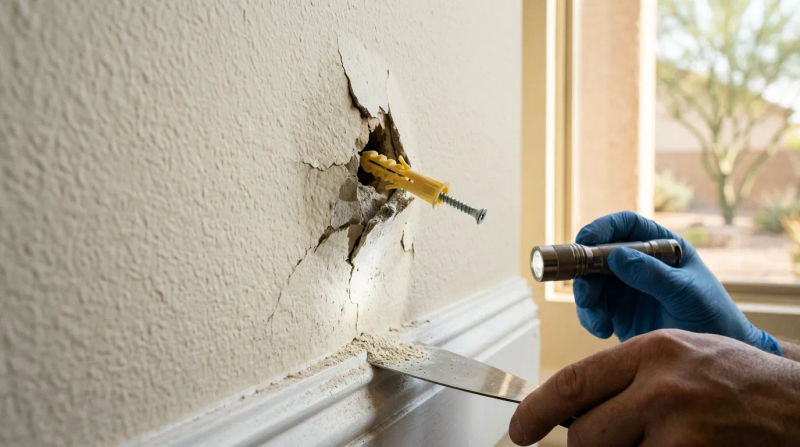
That feeling is a familiar one for many homeowners. You decide to tackle a weekend project - maybe rearranging the living room or finally hanging that new mirror. As you remove the old shelf, a small piece of the wall comes with it, leaving behind a crumbly, widened hole where a sturdy anchor used to be. Suddenly, your simple redecorating task has turned into a wall repair job.
Here in Tucson, as the intense summer heat gives way to cooler September nights, I find my team and I get more calls about this exact issue. It’s the season for indoor projects, and that’s when these hidden problems often come to light. What seems like a minor annoyance can actually be a sign of a bigger issue, especially when it comes to heavier items. As a technician who has spent over a decade helping homeowners with these everyday repairs, I’ve seen firsthand how a small, wobbly anchor can become a major headache if ignored.
Common Signs and Symptoms
A wall anchor rarely fails overnight. It usually gives off subtle warning signs long before it pulls completely out of the drywall. Being able to spot these early can save you from a much larger repair down the road. Here are the six most common red flags I tell homeowners to look for:
- The Wobbly Fixture: This is the most obvious sign. If your shelf, picture frame, or towel rack moves or sags when you touch it, the anchor holding it is losing its grip.
- A Visible Gap or “Halo”: Look closely at where the screw head meets the wall. Do you see a small gap forming? Is the paint or wall texture cracking in a circle around the screw? This “halo” indicates the anchor is pulling away from the inside of the drywall.
- Mysterious Dust: Have you noticed a fine, chalky powder on the floor or baseboard directly beneath a wall-mounted item? That’s gypsum dust from the inside of your drywall, and it’s a sure sign the anchor is grinding away at its hole as it loosens.
- Spreading Spiderweb Cracks: Small, hairline cracks radiating out from the anchor point are a serious warning. This means the load is stressing the drywall panel itself, and a failure is likely imminent.
- The “Popped” or Bulging Wall: If the wall surface around the screw looks like it’s pushing outward, the anchor has likely pulled through the back of the drywall and is now pushing the paper face forward. This is a very unstable situation.
- The Screw That Just Keeps Spinning: When you try to tighten the screw, does it just spin in place without getting any tighter? This means the anchor's fins or threads are no longer biting into solid material. It has completely lost its grip and is providing no support.
What Causes This Problem
Understanding why an anchor fails is key to preventing it from happening again. It’s rarely just one thing, but a combination of factors. In my experience, these are the most common culprits, especially in the homes around Drexel Heights.
- The Wrong Anchor for the Job: This is the number one cause I see. A lightweight plastic anchor designed for a 10-pound picture frame will not support a 60-pound television. Every anchor has a weight rating, and exceeding it is a recipe for failure.
- Incorrect Installation: Even the right anchor will fail if installed improperly. Common mistakes include drilling a pilot hole that’s too large, which prevents the anchor from expanding securely, or over-tightening the screw, which can strip the anchor or damage the drywall behind it.
- Gradual Overloading: You might have installed a shelf with the right anchor, but over the years, more and more books, decorations, or other items get added. The weight creeps up, eventually surpassing the anchor’s limit.
- Vibrations and Movement: An anchor holding a coat rack by a busy doorway or a TV mount with an articulating arm is subjected to constant, subtle movements. Over time, this vibration can slowly widen the hole in the drywall and loosen the anchor’s grip.
- The Wall Itself: The age and condition of your drywall play a huge role. Many of the homes I work on in Drexel Heights are classic mid-century Ranch homes from the 1950s. While these properties have incredible character, the drywall from that era can be more brittle than modern sheets. After 60+ years, it can lose some of its structural integrity, making it more susceptible to a wall anchor pulling out Drexel Heights homeowners often face. A simple drywall screw hole fix might not be enough if the surrounding material is weak.
When to Call a Professional
So, you’ve got a loose anchor. Can you fix it yourself? Sometimes, yes. But knowing when to call for help is crucial to ensure a safe and lasting repair.
Good DIY Scenarios: If a single, small anchor holding a lightweight picture frame has pulled out and left a clean hole no bigger than a dime, you can likely handle it. A simple drywall screw hole fix kit from a local hardware store, which often includes spackle and a small patch, can be effective for these minor cosmetic repairs.
When to Call for Help: I always recommend contacting an experienced professional if you encounter any of the following situations:
- The Hole is Large and Damaged: If the anchor has blown out the back of the wall, creating a crater larger than a quarter, a simple spackle job won’t hold. This requires a more robust drywall anchor repair, often involving cutting out the damaged section and installing a new piece of drywall.
- It Was Holding Something Heavy: If the failed anchor was supporting a television, a large mirror, a microwave, or heavy shelving, you need more than a cosmetic fix. It is critical to patch drywall after TV mount failure correctly to restore the wall's strength and ensure it can safely support the weight again. A professional will know how to properly patch the wall and locate a stud or use heavy-duty anchors for a secure installation.
- Multiple Anchors Have Failed: If several anchors along the same shelf or wall have pulled loose, it might indicate a larger issue with the drywall panel itself, or that the original installation was done poorly. A professional can assess the situation and provide a comprehensive solution.
- You Want a Flawless Finish: Matching wall texture and paint so a repair is truly invisible is an art. If the damaged area is in a highly visible location, experienced professionals have the tools and techniques to make the patch disappear completely.
Conclusion
A loose drywall anchor is more than just an eyesore; it’s a warning sign. Paying attention to wobbly shelves, fine dust, or small cracks can help you catch the problem before a heavy object comes crashing down, causing significant damage to your wall and your belongings. While a minor drywall screw hole fix can sometimes be a DIY task, larger holes or those supporting heavy loads require a professional touch to ensure a safe, strong, and seamless result.
Don’t wait for a small issue to become a major repair. Addressing it early saves you time, money, and stress in the long run.
If you notice any of these signs in your home, contact a local handyman service for an inspection and a reliable repair.